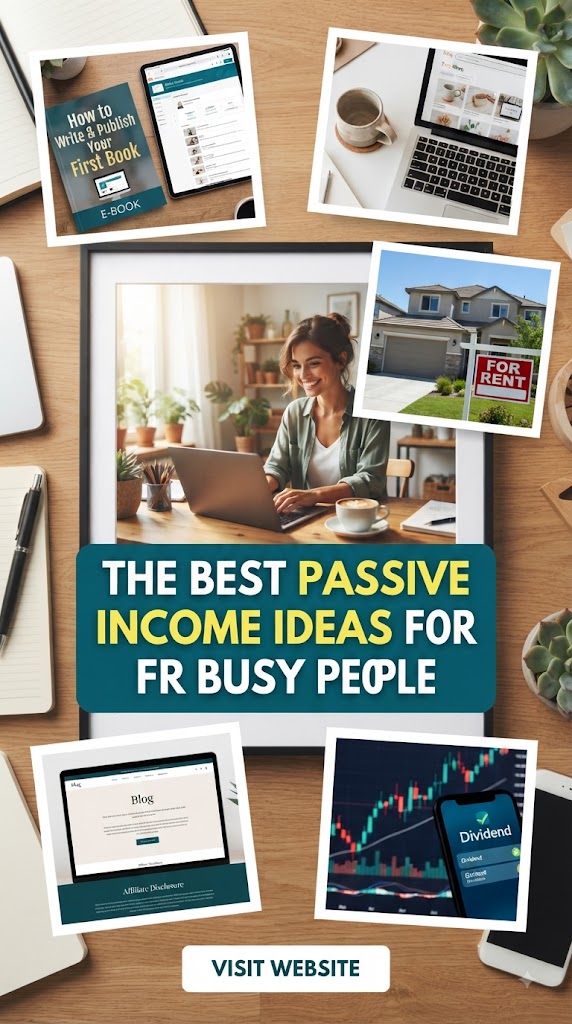
The Ultimate Guide to Passive Income for Busy Professionals: Build Wealth While You Sleep
The concept of “making money while you sleep” has often been dismissed as a pipe dream or a marketing gimmick used by late-night infomercial gurus. However, for the modern, time-strapped professional, passive income is not just a luxury—it is a financial necessity. In an era of economic volatility and the erosion of traditional pension plans, diversifying your income streams is the only true way to achieve long-term financial security.
But here is the catch: most passive income guides suggest “side hustles” that are actually just second jobs. If you are already working 50 hours a week, you don’t have time to drive for Uber or manage a complex dropshipping store. You need strategies that leverage your existing capital or require a one-time setup that yields recurring results with minimal maintenance.
This comprehensive guide explores the best passive income ideas specifically curated for busy people. We will break down the strategies that offer the highest return on environment (ROE) and the lowest time commitment.
1. The Reality of Passive Income: Mindset First
Before diving into the “how,” we must address the “what.” Passive income is rarely 100% passive from day one. It typically requires one of two things:
- Upfront Capital: You use money you’ve already earned to buy assets that generate more money.
- Upfront Time: You spend time building an asset (like a book or a course) that continues to sell indefinitely.
For the busy professional, the goal is to move toward the “Upfront Capital” side as quickly as possible or to use “Upfront Time” in highly concentrated, high-leverage bursts.
2. Dividend Growth Investing: The Gold Standard
Dividend investing is perhaps the most “passive” form of income available. When you buy shares of dividend-paying companies, you essentially become a part-owner of a profitable business that pays you a portion of its earnings regularly.
Why It’s Great for Busy People
Dividend investing requires very little “active” work once your portfolio is set up. With modern brokerage apps, you can automate your investments so that a portion of your paycheck is automatically used to buy shares.
Strategies for Success
- Dividend Aristocrats: Focus on companies in the S&P 500 that have increased their dividend payouts for at least 25 consecutive years. These are stable, blue-chip companies like Johnson & Johnson, Procter & Gamble, and Coca-Cola.
- DRIP (Dividend Reinvestment Plan): Set your account to automatically reinvest dividends to buy more shares. This triggers a compounding effect that can turn a modest portfolio into a massive wealth engine over a decade.
- Dividend ETFs: If you don’t have time to research individual stocks, buy an Exchange-Traded Fund (ETF) like SCHD (Schwab US Dividend Equity ETF) or VIG (Vanguard Dividend Appreciation ETF). These funds do the diversification for you.
3. Real Estate Without the “Landlord” Headaches
Traditional real estate—buying a house, finding tenants, and fixing leaky toilets—is a part-time job. Busy people should avoid this unless they hire a property manager. However, there are ways to gain exposure to the lucrative real estate market without the manual labor.
Real Estate Investment Trusts (REITs)
REITs are companies that own, operate, or finance income-producing real estate. They are traded on stock exchanges just like stocks. By law, REITs must distribute at least 90% of their taxable income to shareholders as dividends.
- Pros: High liquidity (you can sell your shares instantly) and zero maintenance.
- Cons: You don’t get the same tax advantages as physical property ownership.
Real Estate Crowdfunding
Platforms like Fundrise, Arrived, and RealtyMogul allow you to pool your money with other investors to buy into large-scale commercial projects or portfolios of residential homes.
- The Appeal: You can start with as little as $100 or $1,000. These platforms handle all the management, and you simply receive quarterly distributions.
Turnkey Properties
If you want the tax benefits of owning physical property, look into “turnkey” real estate companies. These companies find the house, renovate it, place a tenant, and provide ongoing property management. You simply provide the financing and own the deed.
4. High-Yield Cash Management
In a high-interest-rate environment, leaving your “emergency fund” or “dry powder” in a standard big-bank savings account is a mistake.
High-Yield Savings Accounts (HYSA)
While not a “get rich quick” scheme, moving your cash to an HYSA (like those offered by Ally, Marcus, or SoFi) can earn you 4-5% APY. For a professional with $50,000 in cash reserves, that’s an extra $2,000 to $2,500 a year for doing absolutely nothing.
Certificates of Deposit (CDs) and T-Bills
If you know you won’t need your cash for 6 to 12 months, locking it into a CD or buying U.S. Treasury Bills can provide a guaranteed, state-tax-exempt (in the case of T-Bills) return that is entirely passive.
5. Creating and Licensing Digital Assets
This category requires “Upfront Time” but offers immense scalability. Once a digital product is created, the cost of selling it to the 1,000th customer is zero.
Online Courses and “Mini-Workshops”
If you are a professional with a specific skill set (e.g., project management, coding, corporate law, or even a hobby like photography), you can record a course.
- The Busy Person’s Strategy: Don’t build a 20-hour masterclass. Build a 2-hour “Quick Start” guide. Use platforms like Udemy or Skillshare which already have an audience, so you don’t have to spend time on marketing.
E-books and Self-Publishing
With Amazon KDP (Kindle Direct Publishing), you can publish a book and have it available to millions of readers in 24 hours.
- Leverage: Use AI tools like ChatGPT to help outline your thoughts or transcribe your spoken ideas into text. This significantly cuts down the writing time for busy professionals.
Stock Photography and Templates
If you have a library of high-quality photos or professional templates (Excel spreadsheets, Notion dashboards, Powerpoint decks), you can upload them to sites like Adobe Stock or Etsy. These “digital downloads” sell while you sleep.
6. The “Sharing Economy” for Assets You Already Own
Passive income doesn’t always require buying something new. Sometimes, it’s about monetizing what you already have.
Peer-to-Peer Car Rental (Turo)
If you work from home or take the train to work, your car might be sitting in the driveway 90% of the time. Listing your car on Turo can cover your car payment and then some.
- Making it Passive: Hire a local student or a specialized “fleet manager” to handle the cleaning and key handoffs for a percentage of the profit.
Renting Out Storage Space (Neighbor)
If you have an empty garage, a basement, or even a paved driveway, you can rent it out on Neighbor.com. People pay you to store their boats, RVs, or extra boxes. It is significantly more passive than Airbnb because boxes don’t complain about the Wi-Fi.
7. Automated Business Ownership
This is a higher-level strategy that often requires significant capital but offers the highest income potential.
Vending Machines and ATMs
Buying an existing vending machine route or an ATM in a high-traffic location can provide consistent cash flow.
- The “Busy” Shortcut: You don’t have to stock the machines yourself. You can outsource the “refilling” and maintenance to a part-time contractor, keeping the profit spread for yourself.
Buying a Content Website
Instead of starting a blog from scratch (which takes years to monetize), you can buy a site that is already generating $500–$2,000 a month in ad revenue or affiliate commissions. Platforms like Empire Flippers or Flippa list these businesses.
- Management: Hire a freelance editor to manage the content updates, making your role that of an “investor-manager” rather than a writer.
8. High-Yield Peer-to-Peer (P2P) Lending
Platforms like Prosper or LendingClub allow you to act as the bank. You lend small amounts of money to individuals for debt consolidation, home improvements, or small business expenses.
- Risk Management: The key for busy people is “Auto-Invest.” You set your criteria (e.g., only lend to people with a 750+ credit score) and the platform automatically distributes your money across hundreds of loans to minimize the impact of any single default.
9. Content Creation via “Faceless” Channels
Many people want to benefit from YouTube or social media ad revenue but don’t want to be “famous” or spend hours in front of a camera.
Faceless YouTube Channels
These channels use stock footage, voiceovers (often AI-generated), and scripts to create informative or entertaining videos.
- The Strategy: You can outsource the entire production chain—scripting, voiceover, and editing—on sites like Fiverr or Upwork. Your “work” is simply picking the topics and reviewing the final product.
10. The 5-Step Blueprint for the Busy Professional
If you are overwhelmed by the options, follow this step-by-step plan to build your passive income engine:
Step 1: Optimize Your Cash (1 Hour)
Move your stagnant savings into a High-Yield Savings Account. This is the easiest win.
Step 2: Automate Your Portfolio (2 Hours)
Set up a recurring transfer from your bank to a brokerage account. Set it to automatically buy a Dividend ETF (like SCHD). This ensures you are building wealth every single month without thinking about it.
Step 3: Identify One “Lust-to-Asset” (Variable)
Look at your lifestyle. Do you have an extra room? A car you don’t use? $20k sitting in the bank? Pick the passive income stream that fits your current resources. If you have more money than time, go for REITs. If you have a weekend to spare, create a digital template.
Step 4: Reinvest Everything
In the beginning, your passive income will be small—maybe $10 or $50 a month. Do not spend it. Reinvest every cent back into the asset. This is how you trigger the “Snowball Effect.”
Step 5: Scale and Outsource
Once an income stream reaches a certain level, look for ways to buy back your time. If your Turo car is making $800 a month, pay someone $100 to handle the cleanings. You now have a truly passive $700.
11. Common Pitfalls to Avoid
- The “Shiny Object” Syndrome: Don’t try to do all of these at once. Pick one, get it running, and then move to the next.
- Underestimating Taxes: Passive income is still taxable. In some cases (like short-term capital gains), it can be taxed at a higher rate. Consult with a CPA to see if you should set up an LLC for your ventures.
- Ignoring Risk: Higher returns usually mean higher risk. P2P lending and individual stocks are riskier than T-Bills. Diversify your passive income just as you would your investment portfolio.
12. Conclusion: The Best Time to Start is Today
For the busy professional, the ultimate goal of passive income is Time Freedom. It’s about creating a reality where your standard of living is not tied to your hours worked.
You don’t need to quit your job to start. You don’t even need a lot of time. By choosing “low-maintenance” assets like Dividend ETFs, REITs, and automated digital products, you can build a financial fortress in the background of your life.
Imagine where you could be five years from now if you started just one of these streams today. The compounding of money is powerful, but the compounding of action is what truly changes lives. Stop trading all of your time for money, and start letting your money work for you.