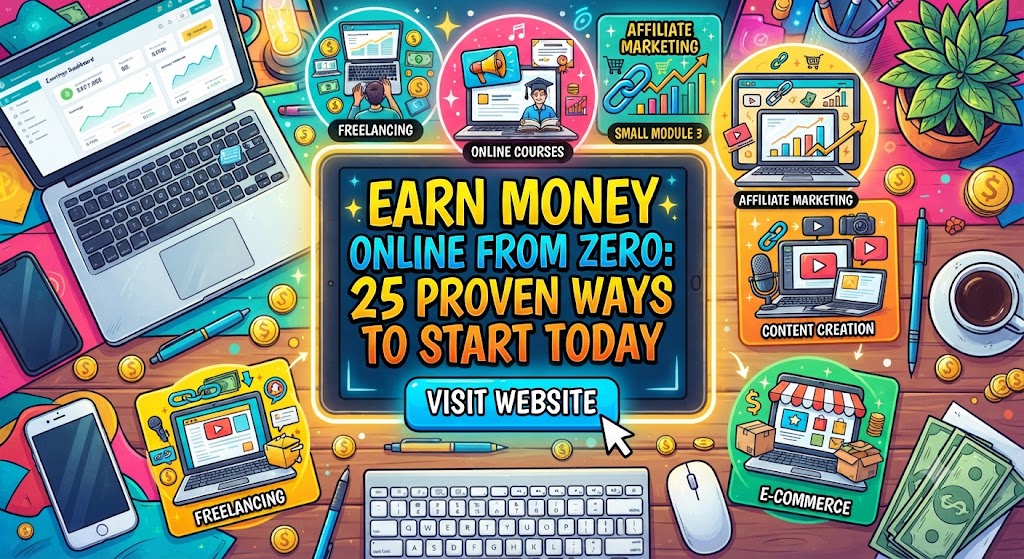
From Zero to Hero: The Ultimate Guide to Earning Money Online with No Experience
If you are reading this, you likely find yourself at the starting line. You have a laptop or a smartphone, an internet connection, and exactly zero dollars in your business bank account. You might feel overwhelmed by the “get rich quick” gurus or the complex jargon of digital marketing. This guide is designed to cut through that noise. We are going to explore a roadmap that takes you from $0 to a sustainable online income, focusing on proven methods, scalable systems, and the psychological shifts required to succeed.
The Psychological Shift: Why “Zero” is Your Greatest Advantage
Starting from zero is often viewed as a disadvantage, but in the world of online entrepreneurship, it is a superpower. When you have no capital to lose, you are forced to be creative. You cannot “buy” your way out of problems with expensive ads or high-end software. Instead, you must develop High-Value Skills.
Before we dive into the methods, you must accept three hard truths:
- Time is your initial currency: Since you aren’t investing money, you must invest hours.
- Consistency beats intensity: Working one hour every day is better than a 15-hour marathon once a month.
- The “Lurker” phase must end: You cannot make money by just consuming content; you must start producing.
Phase 1: Quick Wins—Generating Your First $100
If you are at zero, the most important thing is “proof of concept.” You need to see a balance increase in a digital wallet to believe it’s possible. These methods won’t make you a millionaire, but they will provide the seed money for your bigger ventures.
1. User Testing and Market Research
Companies are desperate to know how real people interact with their products. You don’t need to be a tech genius; you just need to think out loud.
- UserTesting & TryMyUI: You are paid to navigate a website or app and record your thoughts. A typical 20-minute test pays $10.
- Prolific: Unlike standard survey sites that disqualify you halfway through, Prolific matches you with academic studies that pay fairly for your time.
- Respondent.io: This is for higher-end focus groups. If you have specific background knowledge (even as a student or a hobbyist), you can earn $50–$150 per hour.
2. Micro-Tasking
Platforms like Amazon Mechanical Turk (MTurk) or Clickworker offer “Human Intelligence Tasks” (HITs). These are small tasks that AI cannot yet do perfectly, such as identifying objects in a photo or transcribing a short audio clip. It’s repetitive, but it’s a guaranteed way to earn while you listen to a podcast.
3. Selling Digital “Clutter”
Do you have old clothes, electronics, or even old university notes?
- Poshmark/eBay: For physical items.
- Stuvia/Nexus Notes: You can sell your well-organized study notes to students globally. This turns work you’ve already done into passive income.
Phase 2: The Freelance Economy—Trading Skill for Scale
Once you’ve earned your first $100, it’s time to move away from “tasks” and into “services.” Freelancing is the fastest way to hit a full-time income because you are solving specific problems for businesses.
1. Identify Your “Minimum Viable Skill”
Everyone has a skill, even if they don’t realize it. Can you:
- Write a coherent email? (Copywriting/Ghostwriting)
- Organize a calendar? (Virtual Assistance)
- Edit a 60-second video? (Short-form Video Editing)
- Manage a Facebook group? (Community Management)
2. The Power of “Cold Outreach” vs. Marketplaces
While Upwork and Fiverr are great, they are crowded. To succeed from zero, you must master the art of the “Cold Email” or “Cold DM.”
- The Strategy: Find a creator or small business on LinkedIn, Twitter, or Instagram. Identify a problem they have (e.g., their YouTube thumbnails are boring, or they don’t have a newsletter).
- The Pitch: “I noticed [Problem]. I took the liberty of creating [Sample Solution] for you. If you like it, I’d love to do this for your next five projects.”
- Why it works: You aren’t asking for a job; you are providing value upfront.
3. Becoming a “Specialist”
A “General Assistant” earns $15/hour. A “Real Estate Lead Generation Specialist” earns $50/hour. As soon as you get your first client, pick a niche. Specialization allows you to charge for results rather than hours.
Phase 3: The Content & Creator Economy—Building Digital Assets
Freelancing is great, but it’s still “trading time for money.” To reach true financial freedom, you need assets that work for you while you sleep. This is where the creator economy comes in.
1. The “Faceless” YouTube Channel
You don’t need a fancy camera or even to show your face. Using tools like Canva, CapCut, and AI voiceovers (like ElevenLabs), you can create “Cash Cow” channels.
- Niches that pay: Finance, Technology, Health, and “Luxury Lifestyle.” These have a high CPM (Cost Per Mille), meaning advertisers pay more to reach those audiences.
- The Strategy: Focus on Search Engine Optimization (SEO). Find out what people are searching for and create the best answer to that query.
2. Blogging and Niche Sites
Blogging isn’t dead; it has just evolved. Instead of a personal diary, think of a blog as a “Resource Hub.”
- Platform: Start with Medium.com if you have $0. They have a built-in audience and pay you based on reading time.
- Scaling: Eventually, move to your own WordPress site. Focus on “Low Competition, High Volume” keywords. If you write about “How to fix a squeaky door on a 2015 Jeep Cherokee,” you will get highly targeted traffic that you can monetize with ads or affiliate links.
3. Newsletters: The New Gold Mine
Social media platforms can change their algorithms and hide your content. An email list is an asset you own.
- Beehiiv or Substack: These platforms allow you to start a newsletter for free.
- Monetization: Once you hit 1,000 subscribers, you can charge for sponsorships or offer a premium, paid version of your content.
Phase 4: Affiliate Marketing—The “Middleman” Strategy
Affiliate marketing is the process of earning a commission by promoting other people’s products. It is the ultimate “zero-cost” business model.
1. Choosing the Right Product
Don’t just promote anything. Look for:
- High Ticket: Products that cost $500+, giving you a $100+ commission.
- Recurring: Software (SaaS) like Shopify or Canva that pays you every month the customer stays subscribed.
2. The “Bridge Page” Strategy
Don’t just spam your link. Create a “Bridge.”
- Step A: Create a helpful video or article (e.g., “Top 5 Tools for Remote Teachers”).
- Step B: Explain why #1 is the best.
- Step C: Provide your affiliate link as the “easy button” for the reader to get started.
3. Organic Social Media Traffic
Use TikTok, Instagram Reels, and YouTube Shorts to drive traffic. These platforms currently have an “organic reach” boom. A single viral 15-second video can generate thousands of dollars in affiliate commissions if the link in your bio is optimized.
Phase 5: The Knowledge Economy—Selling What You Know
By the time you reach this phase, you have likely gained a skill (SEO, writing, video editing, or even just “how to make $1000 online”). Now, you package that knowledge.
1. Digital Products (E-books and Templates)
If you are a master of Notion, sell Notion templates. If you are great at fitness, sell a 12-week transformation PDF.
- Gumroad: A free platform to host and sell digital products. They only take a small cut when you make a sale.
- Etsy: Believe it or not, Etsy is a massive search engine for digital products like planners, budget trackers, and wedding invite templates.
2. Online Courses
You don’t need a 10-hour cinematic course. A “Mini-Course” (1-2 hours of focused video) that solves one specific problem can easily sell for $47–$97.
- Platform: Use Teachable or Thinkific. Or, host it for free on Skool to build a community around it.
3. Coaching and Consulting
This is the highest level of the knowledge economy. People will pay a premium for your direct time and personalized advice.
- Transition: Once you have a successful digital product, offer a “High-Ticket” coaching program for those who want faster results and accountability.
Phase 6: E-Commerce without Inventory (Print on Demand)
Many people think you need thousands of dollars to start a store. With Print on Demand (POD), you don’t.
- The Model: You design a t-shirt, mug, or poster. You list it on your site. When someone buys it, a third-party company (like Printful or Printify) prints it and ships it to the customer. You keep the profit.
- The Design: Use Canva or Kittl. You don’t need to be an artist; “Typography” (text-based) designs often sell better than complex illustrations.
- The Marketing: Use Pinterest. Pinterest is a visual search engine. One “Pin” of your product can drive traffic for years.
The “Zero to $5k” Roadmap: A 6-Month Timeline
If you are starting today, here is how you should structure your journey:
Month 1: The Foundation
- Spend 2 hours a day on UserTesting and Prolific.
- Target: Earn $200.
- Goal: Use this money to buy a domain name and a basic Ring Light or microphone.
Month 2-3: The Service Phase
- Pick one skill (e.g., Writing or Video Editing).
- Perform 5 “Free” jobs for small creators to build a portfolio.
- Start cold emailing 10 prospects a day.
- Target: $1,000/month.
Month 4-5: The Content Phase
- Start your YouTube channel or Newsletter.
- Post daily on Short-form video platforms to drive traffic to your service or affiliate links.
- Target: $2,500/month.
Month 6: The Asset Phase
- Launch your first Digital Product (E-book or Template).
- Automate your client acquisition.
- Target: $5,000/month.
How to Avoid the “Shiny Object Syndrome”
The biggest reason people stay at zero is that they jump from one method to another.
- The 90-Day Rule: Commit to one of the methods above for 90 days before you allow yourself to try something else.
- Ignore the “Earnings Proof”: Don’t get discouraged by someone showing a $100k screenshot. They started at zero once, too. Focus on your own metrics: “How many emails did I send today?” “How many words did I write?”
Essential Tools for the $0 Entrepreneur
You don’t need a $2,000 MacBook. You need these free/cheap tools:
- Canva: For all things design (Free version is powerful).
- ChatGPT: For brainstorming, outlining, and drafting (Your free AI assistant).
- CapCut: The best free video editor for mobile and desktop.
- Notion: To organize your entire business and life.
- Grammarly: To ensure your professional communication is flawless.
- Google Drive: For cloud storage and document sharing.
Common Pitfalls to Avoid
- Buying “Masterclasses” too early: Everything you need to get to your first $1,000 is available for free on YouTube. Don’t spend your last $500 on a course.
- The “Perfectionist” Trap: Don’t wait for your website to be “perfect” to launch. Launch ugly. Fix it as you grow.
- Falling for Scams: If someone asks you to pay a “registration fee” to work, it’s a scam. Real jobs/gigs pay you.
- Ignoring SEO: Whether it’s YouTube, Google, or Etsy, understanding how search engines work is the difference between 10 views and 10,000 views.
The Verdict: Your Journey Starts Now
The internet is no longer a “luxury.” It is the most powerful tool for wealth creation in human history. Starting from zero isn’t an obstacle; it’s the beginning of a narrative.
The difference between those who make it and those who don’t isn’t intelligence or luck. It is the ability to withstand the “Boredom Zone”—the period between starting and seeing results. If you can commit to the process, follow the roadmap, and provide genuine value to others, the money will not just come; it will stay.
Stop scrolling. Start building. Your “Zero” ends today.