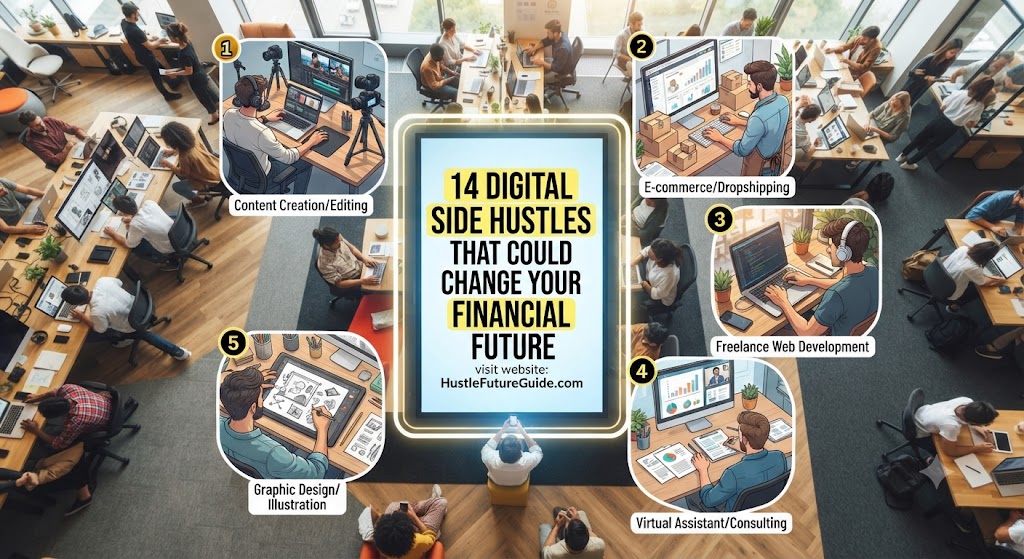
The Digital Gold Rush: 14 High-Potential Side Hustles to Revolutionize Your Income
The traditional 9-to-5 landscape is shifting. We are no longer living in an era where a single paycheck is the only path to financial security. In fact, the “single point of failure” mindset is being replaced by a more resilient, dynamic approach: the digital side hustle.
The internet has democratized access to global markets, allowing anyone with a laptop and a stable connection to build a revenue stream that can eventually outpace their primary salary. But we aren’t talking about filling out $0.50 surveys or clicking on ads. We are talking about high-leverage, high-potential digital businesses that utilize modern tools, artificial intelligence, and specialized skills.
If you are looking to build something that scales, provides freedom, and taps into the booming digital economy, here are 14 digital side hustles with massive potential for 2024 and beyond.
1. AI Prompt Engineering and Workflow Optimization
The rise of Generative AI (ChatGPT, Claude, Midjourney) has created a brand-new niche: the Prompt Engineer. However, the real money isn’t just in “writing better prompts”—it’s in building automated workflows for businesses.
Most companies know they should use AI, but they don’t know how. As a consultant, you can help businesses integrate AI into their daily operations. This could involve creating custom GPTs for their customer service, automating their content calendar using Zapier and OpenAI, or teaching their staff how to prompt effectively to save 10 hours a week.
- The Potential: High. Companies are willing to pay thousands to increase efficiency.
- Skill Level: Intermediate (requires a deep understanding of LLM logic and automation tools).
- How to Start: Master tools like Zapier, Make.com, and various AI playgrounds. Offer a “Proof of Concept” to a small business for free to build your portfolio.
2. High-Ticket Ghostwriting for Executives
The “Creator Economy” isn’t just for Gen Z influencers. CEOs, Founders, and VCs are realizing that their “personal brand” is their most valuable asset. However, these busy individuals don’t have the time to write daily threads on X (formerly Twitter) or long-form thought leadership pieces on LinkedIn.
High-ticket ghostwriting involves adopting the voice of a leader and producing high-quality content that drives engagement and authority. You aren’t just a writer; you are a brand strategist.
- The Potential: $2,000 – $5,000 per month, per client.
- Skill Level: High (requires excellent writing and psychological understanding of branding).
- How to Start: Choose a platform (LinkedIn is best for high-ticket clients). Build your own presence first to show what you can do, then cold-outreach to founders who have a following but inconsistent posting habits.
3. Micro-SaaS Development (No-Code)
You no longer need to be a Computer Science graduate to build software. No-code tools like Bubble, FlutterFlow, and Adalo allow you to build fully functional software-as-a-service (SaaS) products without writing a single line of code.
The trick is to solve a micro-problem. Don’t try to build the next Facebook. Build a specialized tool for a specific niche—like a booking app for independent dog groomers or a lead-tracking tool for solar panel installers.
- The Potential: Exponential. Recurring monthly revenue (SaaS) is the holy grail of side hustles.
- Skill Level: Moderate. You need to learn the logic of no-code builders.
- How to Start: Identify a repetitive problem in a niche you understand. Build a “Minimum Viable Product” (MVP) and launch it on Product Hunt or niche forums.
4. Faceless YouTube Channels (Automation)
YouTube is the second-largest search engine in the world. You don’t need to be on camera to tap into its massive ad revenue and sponsorship potential. “Faceless” channels use stock footage, AI-generated voiceovers (using tools like ElevenLabs), and tight editing to tell stories, give news, or provide tutorials.
Niches like “Personal Finance,” “True Crime,” “Luxury Living,” and “History” perform exceptionally well with this model.
- The Potential: Once a channel is monetized and has a library of content, it becomes a passive income machine.
- Skill Level: Moderate (requires video editing and SEO knowledge).
- How to Start: Use ChatGPT for scripts, Midjourney for visuals, and CapCut for editing. Consistency is key; post 2–3 times a week for six months.
5. Niche Newsletter Curation
In an era of information overload, people are willing to pay for curation. A niche newsletter gathers the most important news, tools, and insights in a specific industry and delivers them to an inbox.
Platforms like Beehiiv and Substack have made it incredibly easy to monetize through subscriptions, sponsorships, and affiliate links. If you can become the “go-to” source for news in a field like “Renewable Energy Tech” or “AI in Healthcare,” you own a valuable audience.
- The Potential: High-growth. Newsletters are being acquired for millions (e.g., Morning Brew, The Hustle).
- Skill Level: Moderate (requires research skills and consistency).
- How to Start: Pick a niche you are passionate about. Commit to a weekly schedule. Use social media to drive traffic to your landing page.
6. Digital Product Ecosystems (Notion Templates & Toolkits)
Selling a single ebook is fine, but building an ecosystem of digital products is where the real potential lies. Many creators are making six figures selling Notion templates that help people organize their lives or businesses.
This can extend to Canva templates, Excel spreadsheets for traders, or “Business-in-a-box” kits for freelancers. Digital products have zero marginal cost of reproduction, meaning every sale after the first is 100% profit.
- The Potential: High scalability. Sell while you sleep.
- Skill Level: Low to Moderate.
- How to Start: Identify a tool people use (like Notion or Figma). Create a template that solves a complex setup problem. Sell it on Gumroad or Etsy.
7. Remote High-Ticket Closing
High-ticket closing is the art of getting on the phone with qualified leads and closing deals for expensive products or services (usually $3,000 to $20,000). Many online coaches, consultants, and agencies have plenty of leads but don’t have the time to do the sales calls themselves.
As a remote closer, you work on commission. If you close a $5,000 coaching package and get a 10% commission, that’s $500 for a 45-minute phone call.
- The Potential: High. Six-figure potential without owning a business.
- Skill Level: High (requires elite communication and sales skills).
- How to Start: Take a course on high-ticket sales. Approach established creators who are currently running ads to a “book a call” funnel.
8. User-Generated Content (UGC) Creator
Brands have realized that polished, professional commercials don’t work as well as “authentic” content from real people. UGC creators are paid to film short, selfie-style videos reviewing or using a product. These videos are then used by the brand for their TikTok or Instagram ads.
Unlike traditional “influencing,” you don’t need a huge following. Brands are paying for the content, not your audience.
- The Potential: $150 – $500 per video.
- Skill Level: Low to Moderate (requires a good phone camera and an eye for social media trends).
- How to Start: Create a portfolio of 3–5 videos featuring products you already own. Reach out to brands on platforms like Insense or Billo.
9. Specialized Virtual Assistant (Operations Manager)
The “General VA” market is saturated and low-paying. However, the “Specialized VA” or “Online Business Manager” (OBM) is in high demand. Instead of just answering emails, you manage a creator’s entire backend.
You handle their launch schedule, manage their small team of editors, set up their email funnels, and ensure the business runs smoothly. You aren’t an assistant; you are the “Right Hand.”
- The Potential: $30 – $100 per hour.
- Skill Level: Moderate to High (requires organizational and project management skills).
- How to Start: Learn the “Creator Stack” (Kajabi, ConvertKit, Slack, Trello). Market yourself as an OBM rather than a VA.
10. Digital Real Estate (Domain & Website Flipping)
Just like physical real estate, digital assets appreciate in value. This hustle involves either “flipping” premium domain names or buying undervalued, under-monetized websites, improving them, and selling them for a profit.
If you can find a blog that is getting traffic but has terrible ads and no affiliate links, you can buy it, optimize the SEO and monetization, and sell it for 30x its monthly profit on platforms like Flippa or Empire Flippers.
- The Potential: Massive capital gains.
- Skill Level: High (requires SEO and business valuation knowledge).
- How to Start: Start small on Flippa. Look for sites in the $500 range. Practice improving their traffic and revenue before moving to bigger “properties.”
11. Podcasting as a Service (PaaS)
Everyone wants a podcast, but almost no one wants to edit it. Podcasting as a Service involves taking a raw Zoom recording from a client and turning it into a professional production.
This includes audio cleaning, adding intros/outros, creating “show notes,” and—most importantly—creating “short-form clips” for TikTok and Reels to promote the episode.
- The Potential: Monthly retainers of $1,000+ per client.
- Skill Level: Moderate (requires audio/video editing skills).
- How to Start: Learn tools like Descript, Adobe Podcast, and Riverside.fm. Offer a “Starter Package” to new podcasters to get them off the ground.
12. Online Course Consultant and Instructional Designer
There is a huge difference between “knowing a lot about a topic” and “knowing how to teach it.” Many experts want to launch an online course but have no idea how to structure a curriculum that actually helps students learn.
As an Instructional Designer, you help experts map out their modules, create engaging workbooks, and design the “student journey” to ensure high completion rates and good reviews.
- The Potential: High-ticket project fees ($3k – $10k per course build).
- Skill Level: High (requires understanding of pedagogy and online learning platforms).
- How to Start: Study the science of learning. Reach out to YouTubers or experts who have expressed interest in launching a course.
13. Search Engine Marketing (SEM) for Local Businesses
While many people focus on SEO (which takes months), local businesses (plumbers, dentists, lawyers) often need leads now. They are willing to pay someone to manage their Google Ads (SEM).
If you can prove that for every $1,000 they spend on ads, you can generate $5,000 in revenue, you will never be out of work. You charge a management fee (usually a percentage of the ad spend or a flat monthly retainer).
- The Potential: High. Scalable by adding more clients.
- Skill Level: High (requires certification and a data-driven mindset).
- How to Start: Get Google Ads Certified (it’s free). Offer to manage a small budget for a local business to prove your ROI.
14. Discord/Community Management for Brands
Community is the new moat. Whether it’s a Web3 project, a gaming brand, or a software company, brands are building private communities on Discord or Slack. These communities need “moderators” and “managers” to keep the conversation going, handle disputes, and organize events.
A good community manager increases customer retention and brand loyalty, making them indispensable to the company.
- The Potential: Consistent monthly income with the potential to work for multiple communities.
- Skill Level: Low to Moderate (requires great “people skills” and platform knowledge).
- How to Start: Become active in a community you love. Volunteer as a moderator. Transition into a paid role as the community grows.
Strategic Keys to Scaling Your Side Hustle
Identifying the right side hustle is only half the battle. To turn a “hustle” into a “business,” you need to apply specific strategies that move you away from trading hours for dollars.
1. The Power of the “Niche down”
The biggest mistake beginners make is being too general. Don’t be a “Graphic Designer.” Be a “Graphic Designer for SaaS Landing Pages.” When you are a specialist, you can charge premium prices because you understand the specific pain points of that industry better than a generalist.
2. Productize Your Service
If you find yourself doing the same task over and over for clients, turn it into a “product.” Create a standardized package with a set price and a set delivery time. This removes the “discovery call” friction and allows you to build a streamlined system for fulfillment.
3. Leverage Automation
In 2024, if you are doing a task manually that a bot could do, you are losing money. Use tools like Make.com or Zapier to connect your apps. For example, if a client pays an invoice, the automation should automatically create a folder in Google Drive, send a welcome email, and invite them to your Slack channel.
4. Build a Personal Brand
Regardless of which hustle you choose, having a presence on LinkedIn or X acts as an “inbound lead machine.” Share your journey, show your results, and talk about the problems you solve. When people see you as an authority, they come to you, which eliminates the need for soul-crushing cold calling.
5. Reinvest for Growth
Once your side hustle starts making $1,000 – $2,000 a month, don’t just spend it. Reinvest that money into tools, courses, or even hiring a part-time assistant. This is how you transition from a “freelancer” to a “business owner.”
Conclusion: The Best Time to Start was Yesterday
The digital economy moves fast. What worked three years ago (like basic dropshipping) is now oversaturated and low-margin. The 14 side hustles listed above are positioned at the intersection of AI, high-value skills, and human connection.
The barrier to entry is lower than ever, but the barrier to success remains the same: consistency and the willingness to learn. You don’t need to quit your job today. You just need to pick one of these paths, commit to one hour of work every evening, and start building your digital leverage.
Whether it’s engineering the perfect AI prompt, ghostwriting for a tech CEO, or building a niche newsletter, the potential for a life-changing income is right at your fingertips. The question is: Which one will you start today?