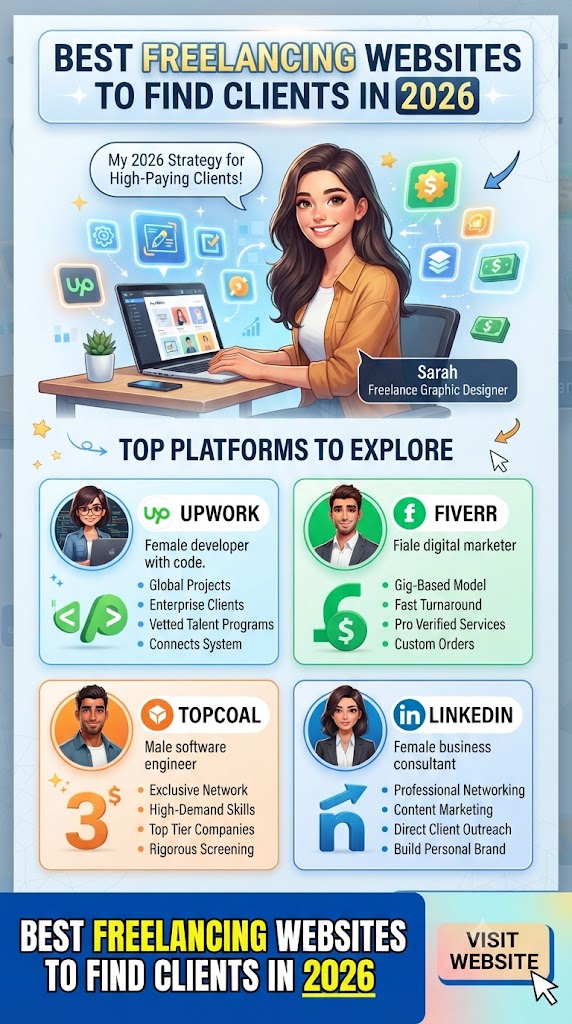
The Freelance Economy
The freelance economy has matured into a sophisticated ecosystem of platforms, each with distinct mechanics, client bases, and competitive dynamics. Whether you are a first-time freelancer or a seasoned professional looking to scale, the platform you choose will fundamentally shape your client acquisition strategy, earning potential, and working relationships. This guide provides a comprehensive analysis of the leading freelancing websites, categorized by their strengths and ideal use cases, so you can make an informed decision about where to invest your time and effort.
Understanding the Different Types of Freelance Platforms
Before diving into specific platforms, it is essential to understand that freelance websites fall into distinct categories. Each solves a different problem and demands a different approach to succeed .
Job Marketplaces are the most common type. They connect freelancers with clients who post projects, allowing freelancers to bid on work or receive invitations. These platforms handle payments, take commissions, and facilitate communication. Examples include Upwork, Fiverr, and Freelancer.com .
Portfolio and Showcase Platforms function differently: they create visibility for your work so clients can find and approach you. These are not transactional platforms but visibility engines. Dribbble and Behance are prime examples, heavily used by designers and visual creatives .
Digital Product Platforms allow freelancers to sell pre-made work such as templates, courses, or presets without delivering custom services. Gumroad and Payhip belong to this category .
Vetted or Curated Platforms screen talent rigorously before accepting them into their network. These platforms position themselves at the premium end of the market and match freelancers with high-value clients. Toptal is the clearest example in this category .
Understanding these categories helps you choose based on your service type, experience level, and business model rather than just platform popularity.
The Major General-Purpose Marketplaces
Upwork: Best for Building Long-Term Client Relationships
Upwork is the largest general-purpose freelance marketplace in the world by transaction volume, with over 18 million registered freelancers and 832,000 active clients as of 2024. Its Gross Services Volume reached $4.1 billion in 2024 . The platform covers virtually every digital service category, from software development and design to writing, legal services, and financial consulting. Web, mobile, and software development represents the single largest category by volume .
The platform operates on a proposal-driven model where freelancers bid on posted jobs or receive direct invitations from clients. Upwork uses a sliding fee structure based on total earnings per client relationship, with freelancer commissions up to 15% . Clients pay service fees of 5% for the Basic plan and 10% for Business Plus .
One of Upwork’s standout features is its transparency: freelancers can see a client’s hiring history, including how many projects they have completed and the total amount they have paid out to talent. This helps identify serious clients before investing time in proposals . The platform also offers robust tools including hourly tracking with screenshots, milestone payments, and escrow protection .
Best for: Experienced freelancers seeking long-term relationships, complex projects, and higher-value contracts . Services that perform well include web development, graphic design, UI/UX, marketing, IT, and virtual assistant roles .
The Challenges: Competition is global and intense. The Connect system requires freelancers to spend currency to submit proposals, which can be costly for beginners. The platform rewards profile strength, clear positioning, and high proposal quality. Most beginners underinvest in all three .
For freelancers, Upwork offers access to a massive job feed and the ability to build a public work history with reviews. The structured system helps connect with verified clients and build professional relationships. However, the platform holds significant leverage: if your account is suspended or your ranking drops, that income can disappear .
Fiverr: Best for Defined, Repeatable Services
Fiverr reverses the typical marketplace dynamic. Instead of clients posting jobs and freelancers bidding, freelancers create structured service listings called “gigs” and clients discover and purchase them. The client finds you; you do not chase the client .
In 2024, Fiverr reported 3.6 million active buyers generating $391.5 million in platform revenue. The platform covers more than 700 service categories. While buyer numbers have declined from earlier peaks, average spend per buyer has increased, signaling a shift toward larger, higher-value transactions .
The structure is fundamentally different from Upwork. On Fiverr, the challenge is creating a gig that surfaces in search and converts visitors into buyers. Once a gig performs well, orders can come in without active outreach. This model works efficiently for executional, well-defined services but is less suited for complex or strategic projects that require extensive back-and-forth scoping .
Fiverr’s commission is 20% of every earning, which is higher than Upwork’s fee structure. However, this covers the platform’s global visibility, secure payment protection, and client support infrastructure . Fiverr Pro offers vetted freelancers and a more premium positioning .
Best for: Beginners, freelancers offering specific and repeatable services like logo design, social media content, short writing pieces, voiceover work, and small marketing tasks .
The Challenges: Quality can vary significantly depending on the freelancer. The platform is not ideal for complex, long-term projects. Gig setup quality directly affects search ranking and conversion, and the preset formatting and character limits can feel restrictive .
For freelancers, Fiverr provides a straightforward entry point with a clean dashboard that displays order status, gig performance, and pending work at a glance. The intuitive messaging tools make client communication smoother. However, the platform’s structure means you have less control over client relationships compared to Upwork’s proposal model .
Fiverr vs. Upwork: The Core Decision
The choice between these two platforms often comes down to your service type and work style. Upwork suits complex, ongoing, or relationship-driven projects where clients want to vet the person before committing. Fiverr suits defined, repeatable services where the scope is clear and the purchase decision is quick. Upwork is proposal-driven; Fiverr is product-driven .
Niche and Specialized Platforms
Toptal: Elite Talent for Complex Projects
Toptal positions itself at the premium end of the freelance market, specializing in providing the top 3% of global freelancers in software development, design, finance, and consulting . The platform operates on a curated matching model rather than open job postings. Clients pay a $79 monthly subscription fee if they proceed with a talent search, and freelancer rates range from $60 to $200+ per hour with up to 50% platform markup .
Toptal’s rigorous screening process is the key differentiator. Less than 3% of applicants are accepted, and the process can take 2 to 5 weeks to complete . Companies like Airbnb, Duolingo, Motorola, and Shopify have used Toptal for their freelance needs .
Best for: Highly experienced professionals who can pass selective screening and want access to high-paying client work. The platform is suited for enterprise-level projects requiring exceptional technical skill, including advanced UI/UX design, enterprise software development, and custom backend solutions .
The Trade-offs: Toptal is very expensive for clients and not suited for small or budget-constrained projects. For freelancers, the entry process is selective and provides limited control over pricing transparency .
Freelancer.com: Competitive Bidding and Global Reach
Freelancer.com is a large open marketplace where businesses can post projects and receive bids from freelancers globally. It uses a competitive bidding environment where clients post projects and freelancers submit bids to win the work, often attracting clients looking for cost-effective solutions .
The platform covers an extensive range of categories including data entry, copywriting, software engineering, scientific research, web development, graphic design, and marketing . Freelancer.com charges a service fee starting from 3% on fixed-price projects and 3% per milestone for hourly projects .
Best for: Freelancers comfortable with competitive bidding and seeking high volume of potential gigs. The platform can be particularly useful for entry-level positions or those looking to gain diverse experience quickly .
The Challenges: Quality can be inconsistent, requiring careful vetting and filtering from clients. The platform has a busy fee structure and high competition. Customer support response times can be slow .
Freelancer.com tends to be volume-driven and price-competitive, making it suitable for freelancers looking for quick projects and early reviews. If your goal is long-term positioning, higher rates, and sustainable client relationships, Upwork is often the stronger choice .
Portfolio and Showcase Platforms
Behance and Dribbble: Creative Visibility Engines
Behance and Dribbble serve a fundamentally different function than job marketplaces. They do not connect you with clients who have posted specific jobs. Instead, they create visibility for your work so clients find and approach you .
Behance operates as a social network for creative professionals, allowing freelancers to showcase portfolios and display works across animation, illustration, web design, graphic design, and more. It has a close connection to the Adobe ecosystem and attracts a broad creative audience .
Behance is free to use and offers a job board in addition to portfolio functionality. However, it does not function as a transactional platform and has significant competition. For creatives, combining a Behance profile with a personal website creates a complete online presence .
Dribbble serves a similar function but with a tighter focus on the design community. Designers and artists build portfolios, boost their brands, and connect with clients. The platform offers a job board for freelance gigs, though premium users can access the full list of freelance jobs .
Dribbble is particularly valuable for designers, illustrators, and visual creatives who want to signal quality to prospective clients already looking for talent. A strong Dribbble presence can attract inbound client interest without active outreach .
Other Notable Platforms
PeoplePerHour: UK and EU Focus
PeoplePerHour connects businesses with freelancers in the UK and Europe, making it especially useful for localized content creation or projects targeting Western audiences. The platform offers curated freelancer talent and fixed-price “Hourlies” for small tasks .
Best for: UK/EU-based content writing, Shopify or WooCommerce support, and localized marketing content. For freelancers, PeoplePerHour offers a smaller talent pool compared to Fiverr or Upwork but with potentially lower competition .
Contra: Commission-Free Portfolio Platform
Contra straddles the line between portfolio platform and marketplace. It functions as both a project-based hiring platform and a profile showcase, operating without taking a commission from freelancer earnings. Freelancers on Contra tend to be mid-to-senior level, and the platform positions itself toward professional independent work rather than entry-level gig volume .
Guru: Structured Project Management
Guru is a freelancing marketplace that connects businesses with freelancers across various industries. It offers flexible payment models including hourly, fixed-price, and task-based rates, with a 9% commission for basic accounts .
Best for: Freelancers who prefer defined scope work and milestone payments. Guru encourages direct communication and transparency between clients and freelancers, with tools for project management and secure payments. The platform has less competition than the largest marketplaces .
FlexJobs: Remote and Flexible Opportunities
FlexJobs is a niche career site for remote and flexible job options, checking companies before job postings to provide a secure and reliable job search space. It offers specialized employment opportunities in content creation, advising, client support, and other sectors .
The Trade-off: FlexJobs operates on a subscription-based model with a small fee. While this filters out scam jobs and provides career resources, it also limits the freelance opportunities available compared to larger platforms .
Choosing the Right Platform
The definition of “best” is not fixed. It depends on your service type, the clients you want to reach, your experience level, and whether you prioritize volume of opportunities or quality of matches .
For Beginners
New freelancers often benefit from platforms with lower entry barriers. Fiverr allows you to create gigs and start selling without bidding or proposal writing, making it accessible for those with defined services . Upwork offers diverse projects across categories but requires investment in Connects and proposal quality . Freelancer.com provides competitive bidding and a large volume of projects, though quality can vary .
For Experienced Professionals
Toptal offers access to high-paying clients but requires passing a rigorous screening process . Upwork remains valuable for building long-term client relationships, with its transparent client history and structured tools .
For Creative Professionals
Behance and Dribbble provide visibility and inbound client attraction without transaction fees. For designers, illustrators, and visual creatives, these platforms are essential for showcasing work and building a reputation .
For UK and EU Markets
PeoplePerHour offers localized opportunities with less competition than global platforms, particularly for content creation and digital services targeting Western audiences .
Practical Tips for Platform Success
Regardless of which platform you choose, certain principles apply across the board.
A strong profile is essential. On Upwork and Fiverr, profile strength directly affects search ranking and invitation rates. Invest time in writing clear descriptions, adding portfolio items, and setting competitive but fair pricing .
Quality over quantity in proposals. The Connect system on Upwork encourages freelancers to refine their pitches rather than submitting generic applications. Clients receive serious, relevant applications when freelancers invest in their proposals .
Treat platforms as a channel, not the whole business. Platform income can disappear if your account is suspended or your ranking drops. Use platforms to build client relationships that can eventually move off-platform, and maintain a personal website or portfolio as a backup .
Factor in fees when pricing. Platform commissions and service fees directly reduce your take-home rate. Your pricing needs to account for this gap. Fiverr charges 20%, Upwork charges up to 15%, and Freelancer.com charges starting at 3% .
Conclusion
The freelance platform landscape in 2026 offers more choice than ever, but each platform serves a specific function. Upwork excels for long-term relationships and complex projects. Fiverr works for defined, repeatable services with a product-driven approach. Toptal provides elite clients for top-tier talent. Behance and Dribbble create visibility for creative professionals. Freelancer.com offers volume for competitive bidders.
The right choice depends on your skills, experience, and business model. Many successful freelancers use multiple platforms simultaneously—building visibility on portfolio sites while actively bidding on job marketplaces. The key is understanding what each platform offers and how to position yourself effectively within its ecosystem.